June 29, 2026
This summer, NOFA-VT is launching a new adaptation planning program for farmers across Bennington and Rutland counties to collaboratively develop adaptation plans that strengthen whole farm climate resilience. This program combines NOFA-VT’s existing adaptation planning framework with a farmer cohort model to support farms in developing actionable, farm-specific adaptation plans, while also creating a space where you can learn from peers, deepen community connections, and build the skills to support lasting resilience across southwest Vermont. Participants also receive $5,000 in seed funds to jumpstart one of their priority projects.
Program Details
Adaptation Planning Process
The adaptation planning process utilized in this program includes three steps: pre-work, resilience assessment, and action planning.
During the pre-work phase, farmers identify holistic goals, reflect on the farm’s weather/growing history, and assess their business’s current financial and ecological health. This pre-work is used as the foundation for adaptation planning.
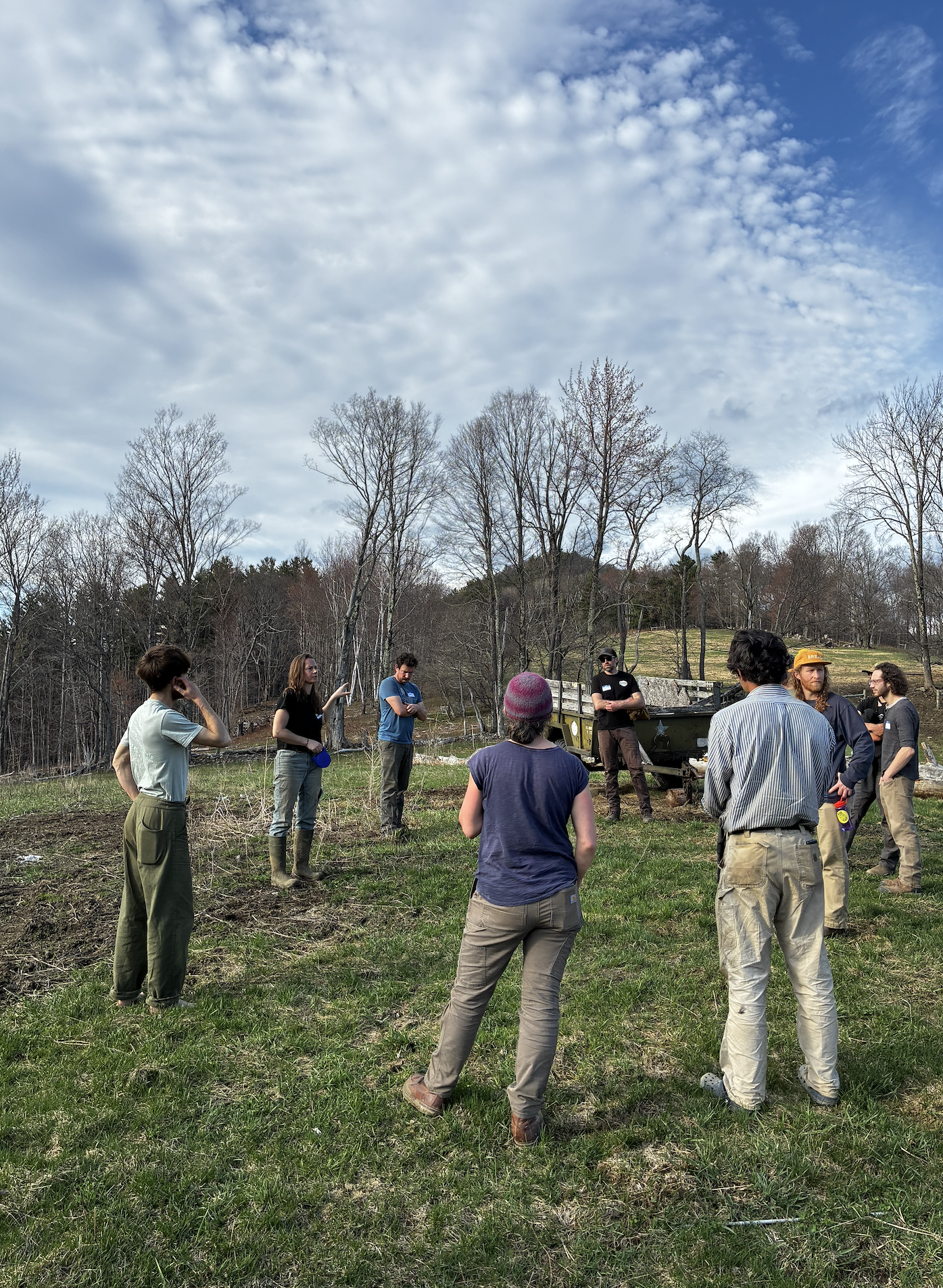
The resilience assessment phase comprises a farm visit where technical service providers and the farmer walk the landscape to identify both potential climate vulnerability and the farm’s unique strengths considering soil, water, markets, supply chain, and infrastructure. After the visit, the planners draft a resilience assessment document systematizing the risk and resilience areas identified during the farm visit.
During the action planning phase, the farmers and planners identify and prioritize strategies to mitigate the risks identified. The result is an action plan consisting of short-term and long-term strategies that the farm can use to improve their whole farm resilience, with a timeline for planned implementation.
Climate adaptation planning is an iterative process and farmers are encouraged to evaluate the impact of their adaptation projects and continue to update their climate adaptation plan regularly.
Cohort Model
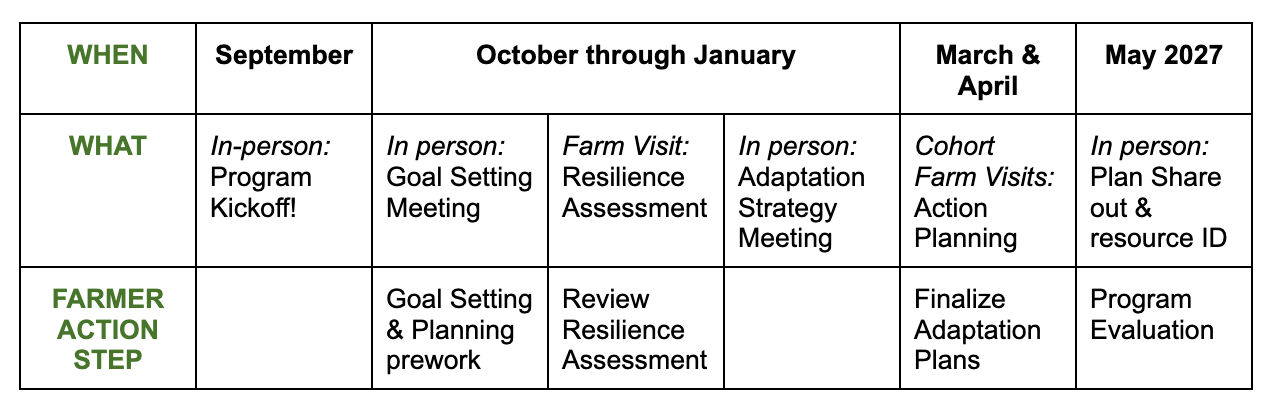
This program will bring farmers together into a cohort who will learn together as a community from late summer of 2026 through the spring of 2027. Over this time, the cohort will meet as a group for four in-person meetings that support the planning process. At these meetings, the cohort will explore approaches to climate adaptation, and learn about available resources to support their action plans. As the program progresses, the full cohort will split into smaller groups of 3-4 farms who will visit one another's farms and collectively support each other through the adaptation process.
This cohort model is intentionally designed to allow for effective planning, while also creating valuable spaces for farmer-to-farmer learning and community connection.
Activity Schedule
The program launches late summer 2026 and over the following 9 months, farmers will work through the adaptation planning process following this schedule:
Upon completion of the program, farms will receive $5,000 seed funds to fund resilience enhancing projects identified through the planning program. These grants can be used individually or combined with those of others in the program to support bigger collaborative projects.
Following the program, NOFA-VT is available to support you and your newly developed action plan with additional resources to facilitate your farm resilience initiatives. This may include: financial analysis, assistance accessing capital, and conservation/organic practice implementation resources with the goal of increasing both climate resilience and profitability.
Program Outcomes and Expectations
What to Expect
Through this program, NOFA-VT will:
- Create a respectful and effective community learning environment.
- Host four in-person gatherings that support the group’s shared learning, including a shared meal at each.
- Facilitate effective and efficient farm visits to support the adaptation planning process.
- Work with each farmer to develop accurate resilience assessments.
- Co-create finalized adaptation action plans that meet the direct needs and goals of each farmer participating in the program.
- Provide $5,000 seed funds to participating farms at the completion of the program.
Participating farms are expected to:
- Participate fully in the program from September 2026 through May 2027, including four in-person meetings and approximately two-three farm visits. The estimated time commitment is approximately 16 hours (not including travel time).
- Complete the necessary prework before the second in-person meeting.
- Attend two Zoom meetings to review resilience assessment and action plan drafts.
- Actively support your fellow cohort members by sharing your ideas, energy, and knowledge during group meetings and farm visits.
- Respond to communications related to the program.
- Participate in the pre- and post-program surveys.
Program Takeaways
Participation in this program provides the farmer with an action plan consisting of short-term and long-term strategies that the farm can use to improve their whole farm resilience, with a timeline for planned implementation. The plan will also include a list of resources, contacts, next steps, and funding options/ideas for the farmer to continue to implement strategies beyond what their seed funds can support. Additionally, if the farmer wants continued support for emergency management planning, business planning, etc, they are able to receive that through NOFA-VT, UVM extension, etc.
Examples projects completed through this program are:
- animal housing/ pasture shade
- irrigation improvements (new or expanded wells and ponds; drip installations)
- greenhouse automation
- raw milk storage tank (A2 milk for on farm sales)
Examples of resources and technical assistance gained during this program are:
- grazing specialist visit: rotation grazing plan, parasite management strategies, etc.
- water and riparian specialist: well and spring infrastructure development support
- grant strategies: applying for NRCS, CEAP, BMP, Working Lands, etc.
- connection to NRCS conservation practices
- connection with farmer mentors and peers
Next Steps
This program is designed to be most valuable for farmers who are interested in active farmer-to-farmer learning, able to commit to the full process, and are excited to explore strengthening climate resilience in community.
Farms are welcome to apply on their own or in groups of up to 3-4. So, if you have neighbors or friends that you’d be excited to plan with, share this with them, consider applying as a mini-cohort, and add their names at the bottom of the application when applying (we cannot guarantee that all farms applying together will be accepted). If participating individually, NOFA-VT will pair you with other similar farms to create the mini-cohorts that will visit each other's farms and support each other through the process.
* Farms that have recently received $1500 grants from NOFA for adaptation planning can participate, but will receive $3500 through this program.
The application period for this program is closed, but NOFA-VT's Farmer Services team offers one-on-one technical assistance for adaptation planning. Request support by filling out this brief questionnaire.
If you have any questions, please feel free to reach out to NOFA-VT’s Farmer Services Team: Kevin Haggerty ([email protected]) or Mia Smith ([email protected]).